Should I explore this?
Examine your reasons, trade-offs, and whether skilled trades genuinely belong on your shortlist.
For Filipino professionals building a life in Canada
Explore skilled trades, verify your options, and build a practical next-step plan—without immediately quitting your job or gambling your family’s stability.
Build the decision.
Then make the move.
You did what responsible people do
You arrived carrying more than luggage. You brought education, experience, discipline, professional pride, and the responsibility to build a better life for the people counting on you.
Then you did what responsible people do: you accepted the work available. It paid the bills. It helped the family. It gave you somewhere to begin.
But the job was supposed to be temporary. Then one year became three. Three became five. And a quieter question became harder to ignore:
You are not ungrateful for the work. You simply know that surviving the beginning was never meant to erase everything you were capable of becoming.
And because your decision affects more than you, “Just take the risk” is not useful advice.
Hindi ka tamad. Wala ka lang malinaw na mapa.
The first important truth
Staying stuck is a decision. Rushing into the wrong path is one too.
The answer is not resigning tomorrow, enrolling in the first program advertised to you, or spending another year collecting browser tabs. The better first move is to build the decision before you make the leap.
The Professional Reclamation method
That is the idea behind The Professional Reclamation Framework: you do not have to solve the next twenty years today. You only need to answer the next honest question in front of you.
Examine your reasons, trade-offs, and whether skilled trades genuinely belong on your shortlist.
Compare your body, family, schedule, location, previous experience, and local evidence—not salary alone.
Put household expenses, apprentice income, school blocks, tools, childcare, and remittances into one honest plan.
Check the current rules where you live and prepare direct questions for employers, sponsors, and tradespeople.
Turn your research into a focused 30-, 60-, or 90-day action plan you can discuss with your family.
A better outcome than another browser tab
Picture opening one folder—not twenty scattered tabs—and seeing the evidence behind your next move. Your options are compared. Your household numbers are written down. Your questions for employers and authorities are ready.
Ninety days cannot guarantee an apprenticeship. They can give you something you may not have today: organized evidence, prepared conversations, and a decision you can explain.
A well-researched “no” can protect your family just as much as a well-researched “yes.”
See the tools that help you build itThen I found myself in the same kind of decision
I was working as a telecom technician when an apprenticeship opportunity appeared. The safe choice was to remain where I was. Starting again meant study, sacrifice, uncertainty, and becoming a beginner while raising a family.
But I kept thinking about the future. I did not want to remain on the tools until my body could no longer carry the load. I wanted to endure the hardest learning years while I was still strong, earn qualifications that could open more doors, and create the possibility of doing less physically demanding work later.
I also did not want to grow older and wonder what my life might have become if I had been willing to try.
When I accepted the opportunity, I had no clear map. I did not know where to obtain the books or ILM modules, whom to contact at school or AIT, or what needed to happen next. My company did not regularly take apprentices, so there was no experienced guide explaining the sequence.
I studied at night after my children were asleep. I sacrificed weekends. Eventually, I became a Journeyman Electrician and then earned my Red Seal endorsement.
I created this package because other Filipino professionals should not have to piece together a life-changing decision through the same confusion, mistakes, and trial and error.
I cannot choose your path for you or promise your journey will look like mine. But I can give you the organized framework I wish I had.
Rich Cabansag, RSECreator, The Professional Reclamation Framework
The roadmap I wish I had
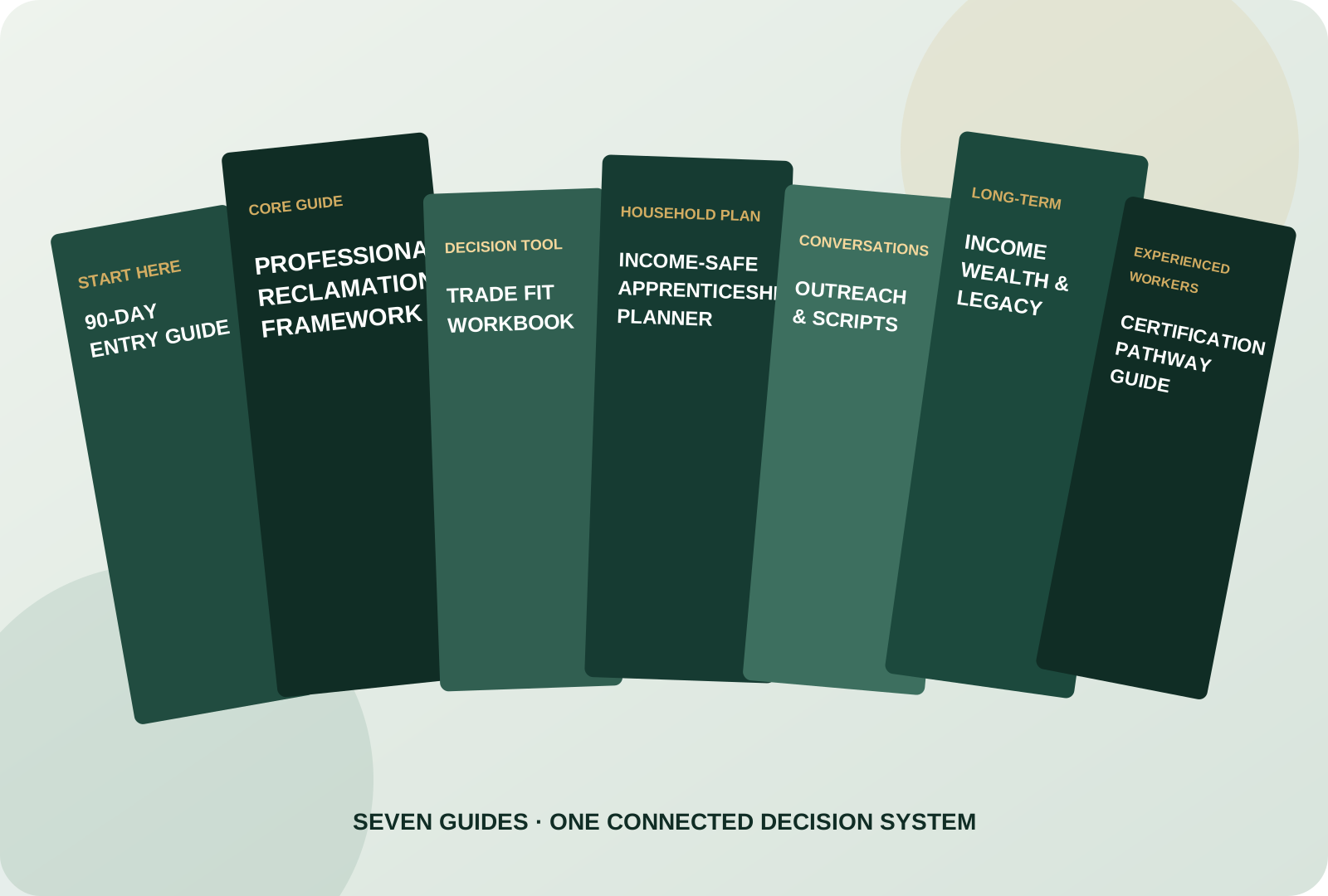
You begin by understanding the whole journey. Then each guide helps you answer the next question—before uncertainty turns into an expensive commitment.
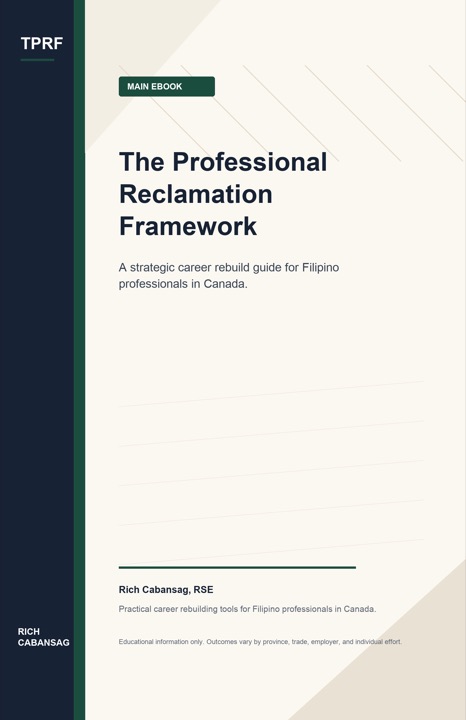
Your first question: What would rebuilding actually require? See the complete journey before choosing a trade—from professional identity and trade fit to apprenticeship entry, income-safe transition, first-year momentum, and longer-term family goals.
You create: a clearer view of the decision, its sequence, and the questions you must answer.
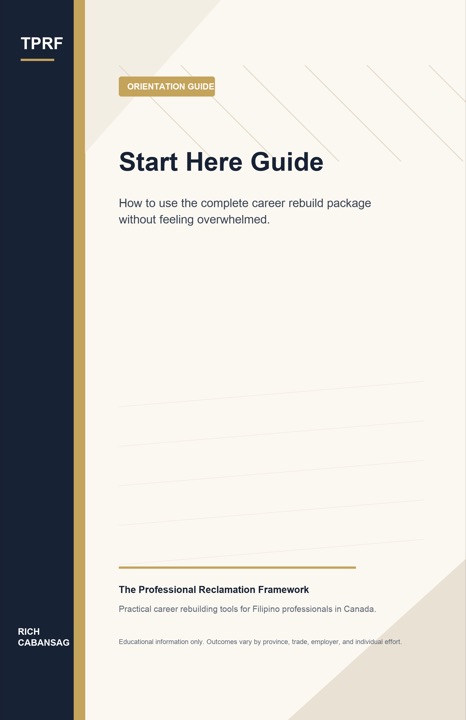
Where do I start? Choose the right reading path, set your first target, and turn the package into a 90-day sequence.
You create: a sequence and first 90-day target.
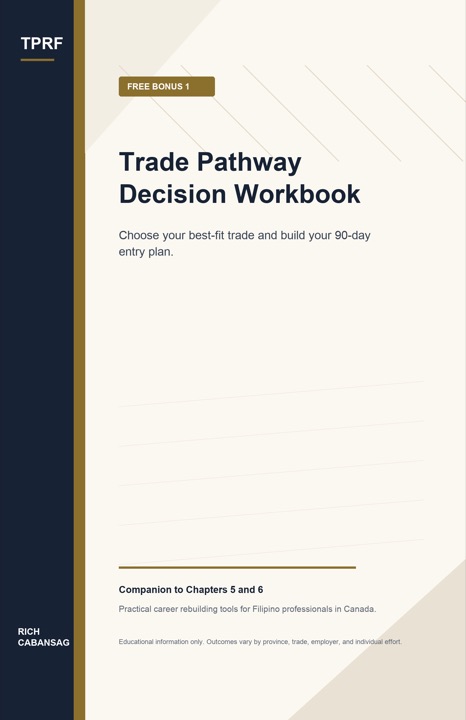
Which trade fits my real life? Compare your shortlist through nine criteria that go beyond the highest advertised wage.
You create: a primary, secondary, and backup trade.
Can our household carry the transition? Record your baseline, prepare for training interruptions, and bring real numbers into the family conversation.
You create: a cash calendar and family agreement.
What do I say when it is time to reach out? Use ten scripts, helper-registration questions, a follow-up system, and a 25-contact tracker.
You create: messages, calls, follow-ups, and records.
What happens if the income finally rises? Set household rules around spending, vehicles, remittances, emergency savings, side-work risks, and physical longevity.
You create: written household rules and one immediate action.
Does my previous hands-on experience matter? Investigate assessment or recognition routes before assuming you must begin from the first step.
You create: an evidence file, authority questions, and a verified next-route decision.
One connected system
Before you decide
TPRF is built to support a better-researched decision—not push every reader toward the same destination.
Read before buying
Age alone cannot answer that question. Your health, target trade, physical demands, schedule, experience, finances, and local entry opportunities all matter. The Trade Fit Decision Workbook helps you examine those factors instead of accepting a generic yes or no.
The package cannot answer without your real numbers. The Income-Safe Apprenticeship Planner helps you build a baseline, consider technical-training interruptions, identify gaps, and decide what must change before you move.
That is why the package does not begin with “pick the highest wage.” You compare candidates using nine criteria, local evidence, and tiebreakers before committing.
No. Your next step may be research, conversations, financial preparation, or ruling out unsuitable paths while keeping your current income.
Entry varies by trade and jurisdiction. Employer involvement and official registration are central in many pathways; other routes may include pre-apprenticeship or school-based options. Verify your exact trade and location before enrolling or resigning.
No. Rich’s experience as an electrician informs the framework, but the decision tools help readers investigate multiple skilled trades using local information.
Not necessarily. Some trades and jurisdictions may have experienced-worker assessment or recognition routes. They are not shortcuts. The included guide helps you organize evidence, prepare authority questions, and verify whether assessment, apprenticeship, or more documented experience is the appropriate next step.
No. The package is written for readers across Canada and includes official starting resources. Apprenticeship is regulated provincially and territorially, so you must verify the rules where you live or plan to work.
No. Employers, economic conditions, apprenticeship authorities, your qualifications, and your actions affect outcomes. TPRF helps you become more informed, prepared, and organized.
That can still be a valuable outcome. A well-researched “no” may prevent you from spending major time and money on a poor fit.
Much of the official information is public. The value is the organized sequence connecting career fit, local verification, household planning, outreach, follow-up, and a 90-day decision process in one system.
Yes. The framework treats your previous discipline, technical thinking, communication, leadership, and responsibility as experience to translate—not erase.
After successful payment, you receive access to a private customer area where you can download the complete package of seven PDF guides.
You already proved you can work hard
Your next chapter does not require you to erase your past or make a reckless leap. It asks you to investigate your options, tell yourself the truth, protect what matters, and take one informed step.
See the complete offerHindi ka starting from zero. You are building from experience.
You have seen the complete roadmap
Receive the core framework, 90-day entry guide, four practical companion tools, and the experienced-worker pathway guide—all designed to move one decision into the next.
CAD$67
one-time paymentIf it is not right for you, email support@takethenextstep.ca within 14 calendar days of purchase for a full refund to your original payment method. No explanation is required. Customer-area access ends after the refund is issued.
Secure checkout powered through Systeme.io and Stripe.
Educational planning tools only. No employment, income, apprenticeship placement, certification, immigration, tax, or financial outcome is guaranteed.